The Living Word: Speech, Writing, and the "Writing-to-Read" Journey
Let’s step into the heart of the Waldorf Language Arts curriculum. In a world that often rushes children to "decode" abstract symbols as early as possible, Waldorf takes a different path—one that mirrors the history of humanity itself.
Before humans had books, we had stories. Before we had the alphabet, we had symbols and art. By following this natural evolution, we ensure that when a child finally picks up a book to read, they aren't just identifying sounds; they are connecting with a world of meaning they already love.
1. The Foundation: A Love of Beautiful Speech
In Waldorf, literacy begins with the ear, not the eye. We believe that a child’s capacity for reading comprehension is directly linked to the richness of their oral language.
• Beautiful Speech: As teachers, we consciously "enliven" our speech. We use enunciation, inflection, and rich vocabulary, avoiding shortened language or slang.
• The Power of Storytelling: We don’t just read from a book; we tell stories from memory. This oral tradition allows for eye contact and the use of gestures, which research shows helps children build mental "story maps."
• Poetry and Song: We bathe children in the "musicality" of language. Vowels are the emotions (the music), and consonants are the structure (the sculpture). By reciting verses daily, children develop a sophisticated sense of syntax and phonological awareness long before they ever see a phonics worksheet.
2. The Morning Circle: Language in Motion
The "Morning Circle" is more than a transition; it is a neurological "wake-up call." Science now confirms what Waldorf has practiced for a century: movement is the architect of the brain.
During our 20–30 minute circle time, we engage in:
• Rhythmic Movement: Clapping, stomping, and bean-bag passing to rhythmic verses. This integrates the left and right brain hemispheres.
• Proprioceptive Input: Deep movement helps children understand where their body is in space. Research by pediatric experts like Dr. Susan Johnson suggests that this spatial awareness is a prerequisite for the eyes to track letters across a page correctly.
• Memorization through Joy: Because these songs and poems are repeated for weeks, they become part of the child's "living library." They are learning complex vocabulary and grammar "by heart"—quite literally.
3. The "Writing-to-Read" Sequence
In Waldorf, we don't teach reading; we let reading emerge. The sequence is always: Doing -> Experiencing -> Writing -> Reading.
1. The Image: We tell a story about a "Snake" who hisses through the grass.
2. The Art: The children draw a beautiful, curving green snake in their Main Lesson books.
3. The Letter: Out of the curve of the snake, the letter 'S' is revealed. The symbol is now a friend, not an abstract squiggle.
4. The Writing: Children write words they have already spoken and sung.
5. The Reading: Finally, the child "reads" their own writing. Because they wrote it, they know what it says. This builds an immediate sense of confidence and mastery.
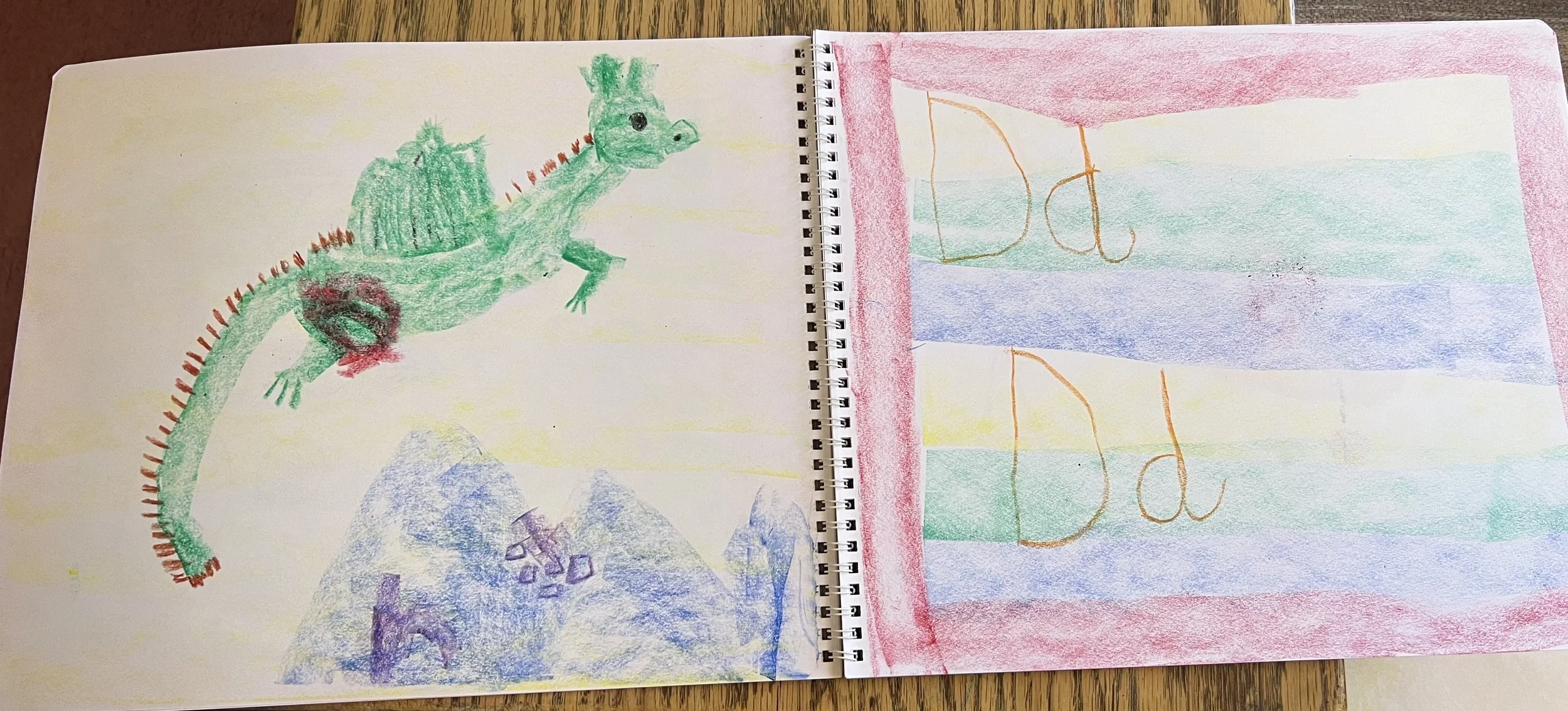
Capital D was found in the dragon’s curved leg
Why It Works: What the Research Says
While the traditional "push" for early reading is common, studies suggest the Waldorf approach offers long-term advantages:
• The "Late Bloomer" Advantage: Research by Sebastian Suggate at the University of Regensburg compared children who learned to read at age 5 with those who started at age 7. By age 11, there was no difference in reading ability—except that the later starters often showed a greater love for reading and better comprehension because they hadn't been "burned out" by early pressure.
• Neuroplasticity and Play: A 2010 study in the Journal of Cognition and Development found that the "imaginative play-rich" environments of Waldorf schools support stronger narrative skills. Children who can visualize a story in their mind are far better at comprehending complex texts later in life.
• The "Velcro" Effect: Educational researchers often use the "Velcro" analogy—new knowledge sticks best to existing knowledge. By spending years on oral stories and background knowledge, Waldorf children have a massive "scaffold" for new information to stick to (Wexler, The Knowledge Gap).
In Waldorf, we don't just teach a child how to read; we give them a reason to want to read. We ensure that their "inner library" is full of beauty and wonder before they ever open their first book.